
When does cane spirit become rum?

Updated: 3 days ago
Every spirit FNQ Rum Co. makes begins as the same thing: North Queensland sugarcane. Some of it leaves here called rum and some of it leaves here called cane spirit. The difference is not a matter of house style. In Australia the word rum has conditions attached to it, and they are worth knowing before you choose a bottle.

Everything here starts as cane
Cane juice, reduced to syrup and fermented, then distilled. That is the shared beginning for the whole FNQ Rum Co. range, and there is a separate article on why we work from cane syrup rather than molasses if that is the part you came for.
What happens after the still is where the range divides.
What Australian law actually requires
For a spirit made in Australia, the definition sits in the Excise Act 1901 at section 77FI, and it has three parts rather than one. Imported spirits come in under a different provision, which is why a bottle made overseas can be labelled differently from an Australian spirit made the same way.
First, the origin. Rum is defined as a spirit obtained by distilling a fermented liquor derived from the products of sugar cane.
Second, the character. The distillation has to be carried out so that the spirit possesses the taste, aroma and other characteristics generally attributed to rum. That is a judgement about the spirit itself, not a number you can reach by waiting.
Third, the time in wood. A spirit cannot be delivered from excise control described as rum unless it has been matured by storage in wood for at least two years. Storage in wood means exactly that: every surface in contact with the spirit is wood, and time spent in a steel tank does not count towards it.
Miss any one of those three and nothing is disqualified from existing or from being sold. The spirit simply cannot go out described as rum under that provision, and what it is called instead is the producer's own description. That is where a name like cane spirit comes from. It is a description, not a legal category.
Why the wood is the part that takes time
Two years is the floor, and it is a long floor by world standards. It is also the only one of the three conditions that cannot be hurried, which is why it does most of the work in practice. What the tropics do to a barrel while it waits is its own subject.
The same body of rules is more particular than a single threshold suggests. Where spirits are blended, the age counts as that of the youngest spirit in the blend. And the words old and very old are reserved for five and ten years in wood respectively, so they cannot be used loosely either.
Platinum, the cane spirit in the range
Platinum Cane Spirit is the unaged expression. It goes from the still through a volcanic rock filter and into the bottle at 40 percent, with no time in oak, so there is nothing between the cane and the glass. Our catalogue lists it as a Sugarcane Spirit, and that is the honest description of what it is.
It is also the most decorated bottle in the range on recent form: World's Best Sugarcane Spirit at the 2024 World Rum Awards, Gold and a Style Winner at the same competition that year, and a Trophy in the Agricole and Sugarcane Juice class at the 2025 Australian International Rum Awards with 94 points. A spirit does not have to be a rum to win at a rum competition. Those sugarcane classes exist because the category is wider than the single word.
Iridium and Palladium, after the oak

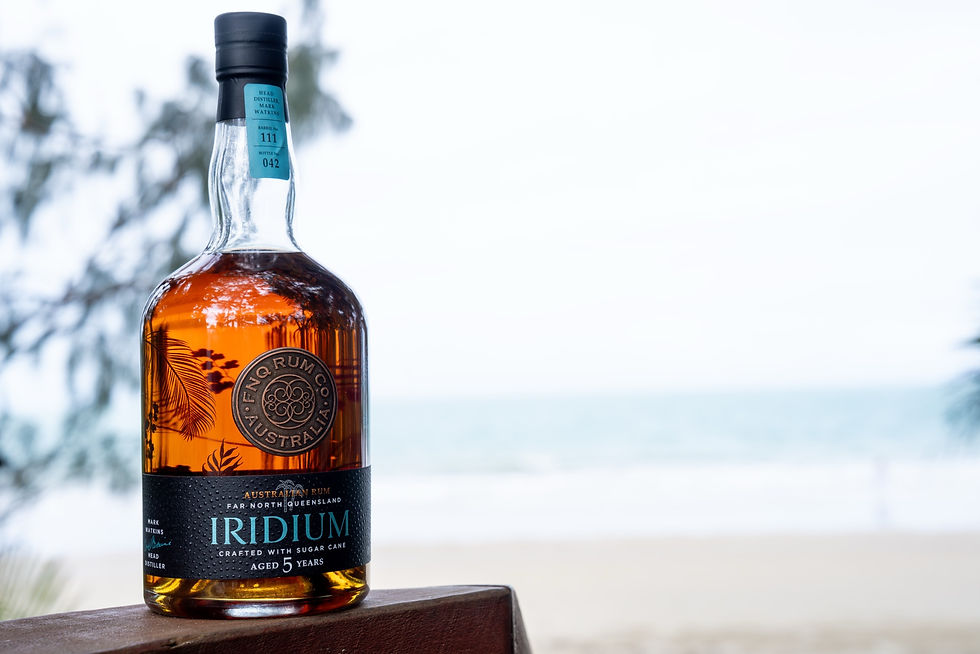
Iridium 5yr Dark Rum is the same North Queensland cane syrup, fermented on site, then matured five years in ex red wine hogsheads. Five years is two and a half times the statutory minimum. It was named World's Best Pot Still at the 2021 World Rum Awards.
Palladium Overproof Rum is aged in American oak hogsheads and bottled at 60 percent. There is more on what each award in the range was actually for if you want the full record.
What this means when you read the range
The range sits across the line rather than on one side of it, which is unusual and is the most useful thing to understand about it. Platinum is the cane before the oak. Iridium is the same cane after five years of it. Choosing between them is mostly a question of how much wood you want between you and the sugarcane.
Common questions
Is cane spirit just young rum?
Not quite. Young rum has been in a barrel and has not been there long. Platinum has never been in a barrel at all, and it is filtered rather than aged. Different intention, different drink.
Does the two year rule apply to imported bottles?
Imported spirits are dealt with under a different provision, so a bottle made overseas may be described differently from an Australian spirit made in the same way. The rule described above is the one that applies to what we distil here.
Which should I try first?
Platinum if you want to taste the cane, Iridium if you want to taste the cask. The cellar door at Mt Uncle Distillery in Walkamin will pour you both, and you can see the rest of the FNQ Rum Co. range online.


Comments